
Nucleic Acids
storing genetic information and more
DNA and RNA are the cell’s way of storing and deploying genetic information. Structural biology is revealing that some nucleic acids also fold to form complex molecular machines. Guided by these structures, nanotech scientists are building new machines composed of nucleic acid.
Molecule of the Month Articles (48)
 |
Adenine Riboswitch in Action
XFEL serial crystallography reveals what happens when adenine binds to a riboswitch |
 |
ATM and ATR Kinases
Dividing cells use ATM and ATR kinases to respond to DNA damage. |
 |
Designed DNA Crystal
Small pieces of DNA have been engineered to form a nanoscale lattice |
 |
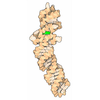
DNA
Atomic structures reveal how the iconic double helix encodes genomic information |
 |
Fluorescent RNA Aptamers
RNA aptamers are being engineered to track molecules inside living cells |
 |
FOXP3
A master transcriptional regulator of immune tolerance |
 |
Histone Ubiquitination and Deubiquitination Complexes
Enzymes that add and remove marks from chromosomes to keep gene regulation in balance |
 |
Histones Across the Tree of Life
Uncovering the evolutionary diversity of histones |
 |
Natural RNA-Only Assemblies
Large and intricate naturally occurring structures composed exclusively of RNA |
 |
Nucleosome
The cell's genome is stored and protected by nucleosomes |
 |
RecA and Rad51
Broken DNA strands may be repaired by matching sequences in a duplicate copy of the DNA |
 |
Restriction Enzymes
Bacterial enzymes that cut DNA are useful tools for genetic engineering |
 |
Ribonuclease P
The ribozyme ribonuclease P cleaves pre-tRNA to form functional tRNA. |
 |
Ribosomal Subunits
Atomic structures of the ribosomal subunits reveal a central role for RNA in protein synthesis |
 |
Ribosome
Ribosomes are complex molecular machines that build proteins |
 |
Riboswitches
Special sequences of messenger RNA can bind to regulatory molecules and affect synthesis of proteins |
 |
Self-splicing RNA
Special sequences of RNA are able to splice themselves |
 |
Small Interfering RNA (siRNA)
Our cells continually look for pieces of double-stranded RNA, a possible sign of viral infection |
 |
Spliceosomes
Cryoelectron microscropy is revealing how spliceosomes cut-and-paste messenger RNA molecules. |
 |
Telomerase
Telomerase maintains the ends of our chromosomes. |
 |
Thymine Dimers
Ultraviolet light damages our DNA, but our cells have ways to correct the damage |
 |
Transfer RNA
Transfer RNA translates the language of the genome into the language of proteins |
 |
Transfer-Messenger RNA
tmRNA rescues ribosomes that are stalled by damaged messenger RNA |
 |
Vitamin D Receptor
Vitamin D helps regulate the use of calcium throughout the body |
|
Adenine Riboswitch in Action
XFEL serial crystallography reveals what happens when adenine binds to a riboswitch |
|
ATM and ATR Kinases
Dividing cells use ATM and ATR kinases to respond to DNA damage. |
|
Designed DNA Crystal
Small pieces of DNA have been engineered to form a nanoscale lattice |
|
DNA
Atomic structures reveal how the iconic double helix encodes genomic information |
|
Fluorescent RNA Aptamers
RNA aptamers are being engineered to track molecules inside living cells |
|
FOXP3
A master transcriptional regulator of immune tolerance |
|
Histone Ubiquitination and Deubiquitination Complexes
Enzymes that add and remove marks from chromosomes to keep gene regulation in balance |
|
Histones Across the Tree of Life
Uncovering the evolutionary diversity of histones |
|
Natural RNA-Only Assemblies
Large and intricate naturally occurring structures composed exclusively of RNA |
|
Nucleosome
The cell's genome is stored and protected by nucleosomes |
|
RecA and Rad51
Broken DNA strands may be repaired by matching sequences in a duplicate copy of the DNA |
|
Restriction Enzymes
Bacterial enzymes that cut DNA are useful tools for genetic engineering |
|
Ribonuclease P
The ribozyme ribonuclease P cleaves pre-tRNA to form functional tRNA. |
|
Ribosomal Subunits
Atomic structures of the ribosomal subunits reveal a central role for RNA in protein synthesis |
|
Ribosome
Ribosomes are complex molecular machines that build proteins |
|
Riboswitches
Special sequences of messenger RNA can bind to regulatory molecules and affect synthesis of proteins |
|
Self-splicing RNA
Special sequences of RNA are able to splice themselves |
|
Small Interfering RNA (siRNA)
Our cells continually look for pieces of double-stranded RNA, a possible sign of viral infection |
|
Spliceosomes
Cryoelectron microscropy is revealing how spliceosomes cut-and-paste messenger RNA molecules. |
|
Telomerase
Telomerase maintains the ends of our chromosomes. |
|
Thymine Dimers
Ultraviolet light damages our DNA, but our cells have ways to correct the damage |
|
Transfer RNA
Transfer RNA translates the language of the genome into the language of proteins |
|
Transfer-Messenger RNA
tmRNA rescues ribosomes that are stalled by damaged messenger RNA |
|
Vitamin D Receptor
Vitamin D helps regulate the use of calcium throughout the body |
Learning Resources (7)
 |
DNA
Paper Model
Atomic structures reveal how the iconic double helix encodes genomic information
|
 |
Paper Nucleic Acid Models for Hands-on Education
Paper Model
Download templates for a set of paper models that can be cut from paper or card stock and used for demonstrations of the fundamentals of DNA structure, DNA replication, and RNA translation.
|
 |
tRNA
Paper Model
Transfer RNA translates the language of the genome into the language of proteins
|
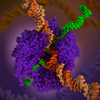 |
Award-winning RNA Polymerase Illustration
Poster
|
 |
The Ribosome
Flyer
This flyer commemorates the 2009 Nobel Prize in Chemistry for studies of the structure and function of the ribosome.
|
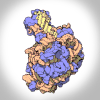 |
Ribosomal Subunits
GIF
Atomic structures of the ribosomal subunits reveal a central role for RNA in protein synthesis. Ribosomes are complex molecular machines that build proteins.
|
 |
Molecular Backgrounds For Virtual Meetings
Other Resources
Download images created by David Goodsell to add a molecular backdrop to your next virtual meeting. Click on the image to expand.
|
Geis Digital Archive (6)
 |
Transfer Ribonucleic Acid (tRNA)
Geis illustrates the structure of transfer ribonucleic acid (tRNA), the nucleic acid that translates the language of the genome into the language of proteins. |
 |
Deoxyribonucleic Acid (DNA)
Geis illustrates three possible forms of deoxyribonucleic acid (DNA). He highlights the differences between each structure by displaying them in a side-by-side manner. |
 |
B-DNA
Geis illustrates B-DNA in blue looking from above, through the double helix. The two bases on top are highlighted in white to distinguish one individual section of the layered scene. |
 |
Z-DNA
In this sketch, Geis illustrates the left handed Z-form of double stranded deoxyribonucleic acid (DNA). Z-DNA is indicated by the zig-zag like pattern of the two strands in relationship to each other. Geis shows a line of symmetry down the middle of the illustration highlighting the helix axis of the molecule.
|
 |
DNA
Geis illustrates a double helix in his depiction of DNA. He portrays the helices with a soft ribbon structure. The white "box-like" structures represent a base pair in the DNA strand.
|
 |
A-DNA
Geis uses a thin ball and stick representation of a section of A-DNA, the more compact conformation of DNA less often seen in biological systems. He draws it from a perspective looking down into the double helix, showing the increase in diameter of the middle of the helix from the B form DNA.
|
Goodsell Molecular Landscapes (7)
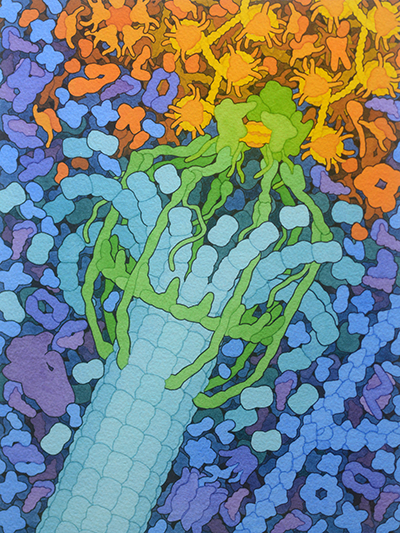 |
Kinetochore
Kinetochores separate chromosomes when eukaryotic cells divide.
|
 |
Escherichia coli Bacterium
A cross-section through an Escherichia coli cell reveals the crowded nature of the cell and diverse molecular processes.
|
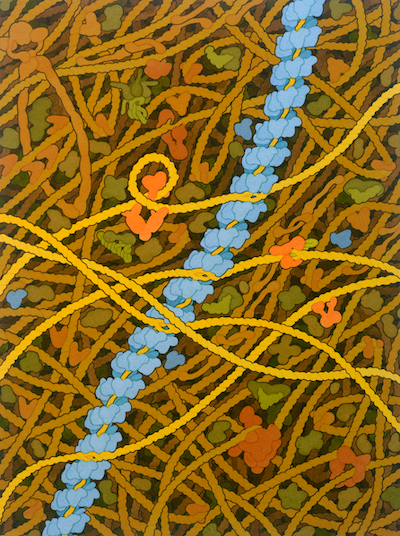 |
RecA and DNA
RecA assists with the pairing of DNA strands during DNA repair.
|
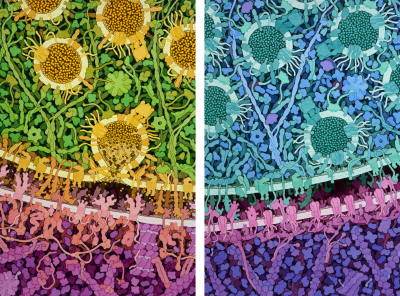 |
Excitatory and Inhibitory Synapses
Excitatory and Inhibitory Synapses (2018) by David S. Goodsell
|
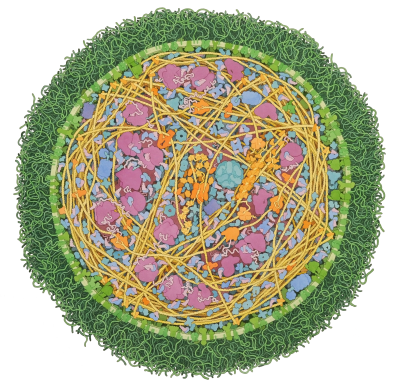 |
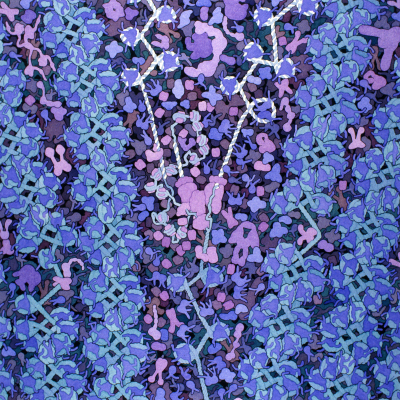
Mycoplasma mycoides
Mycoplasma mycoides (2011) by David S. Goodsell. doi: 10.2210/rcsb_pdb/goodsell-gallery-011
|
 |
Biosites: Nucleus
Biosites: Nucleus (2005) by David S. Goodsell
|
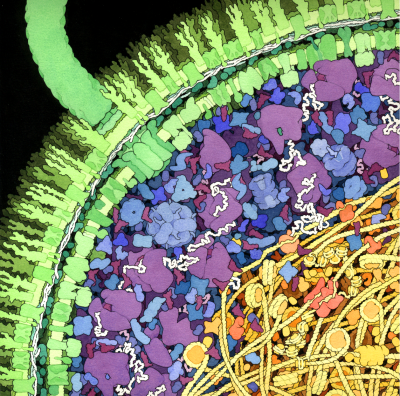 |
Escherichia coli
Escherichia coli (1999) by David S. Goodsell
|